Posts

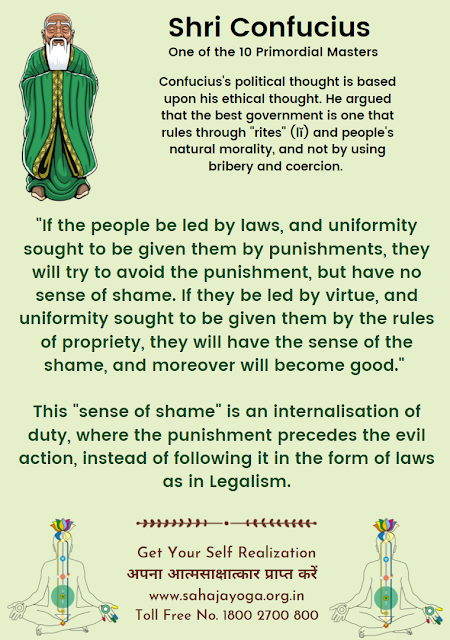
The teachings of Shri Confucius

Image
 The teachings of Shri Confucius Self-discipline The teachings of Confucius are still actively practiced around the world and reforming societies through education. The Noble, he says, is not a Saint; Saints are born and remain such, whilst people become Noble thanks to self-education. His task is education, not contemplation. His aim is the Noble, not the Saint:  “A man of noble mind can acquire a culture by assiduous study and by observing the ancient norms he gives it a complete order” . Research of Balance “The Centre as such only respects two extremes; knowing the two extremes, the Centre will be known as an harmonic point between them. Centre is that state in which neither hope nor rage, neither pain nor happiness will be felt.” “Harmony is the state in which these feelings are manifested, but totally obey to the right rhythm.” “The Constant Middle is the maximum, the apex and the summit, and is few the men who are capable to keep to them for long.” “Balanc...

Confucius’ social philosophy - Love Others

Image
  LOVE OTHERS.... During the sixth century B.C., competing Chinese states undermined the authority of the Chou Empire, which had held supreme rule for over 500 years. Traditional Chinese principles began to deteriorate, resulting in a period of moral decline. Confucius recognized an opportunity — and an obligation — to reinforce the societal values of compassion and tradition. The Golden Rule Confucius’ social philosophy was based primarily on the principle of "ren" or "loving others" while exercising self-discipline. He believed that ren could be put into action using the Golden Rule, "What you do not wish for yourself, do not do to others." (Lunyu 12.2, 6.30).

Shri Confucius - His philosophical teachings, called Confucianism

Image
  Confucius (/kənˈfjuːʃəs/ kən-FEW-shəs; Chinese: 孔夫子; pinyin: Kǒng Fūzǐ, "Master Kǒng"; or commonly 孔子; Kǒngzǐ; 551–479 BCE) was a Chinese philosopher and politician of the Spring and Autumn period who was traditionally considered the paragon of Chinese sages. Confucius's teachings and philosophy formed the basis of East Asian culture and society, and continue to remain influential across China and East Asia today. His philosophical teachings, called Confucianism, emphasized personal and governmental morality, correctness of social relationships, justice, kindness, and sincerity. Confucianism was part of the Chinese social fabric and way of life; to Confucians, everyday life was the arena of religion. His followers competed successfully with many other schools during the Hundred Schools of Thought era, only to be suppressed in favor of the Legalists during the Qin dynasty. Following the victory of Han over Chu after the collapse of Qin, Confucius's thoughts received...

Shri Confucius - 551 BC., China

Image
About Shri Confucius Shri Confucius was born in China in the state of Lu in 551 BC. Son of an aristocratic but impoverished family: his father died when he was three. With the support and encouragement of his mother, Confucius was very diligent in his studies. Living in a period when corruption, wars and anarchy were the basis of politics, he decided to put his attention to the study of the classics i.e. to rediscover of old values. Since his vocation was teaching he founded a school. After his mother's death, according to tradition, Confucius could not exercise public office for three years; so he dedicated this time to the study of his favourite subjects: music, ancient rites and texts. This intense study allowed him to render into mottos the wisdom of the ancestors and to formulate precepts in order to regulate the behaviour of a man as a member of society. He also wandered around China with his students, laying a foundation of rules that has been practiced by his numerous dis...

Story of Shri Zarathushtra

Image
Story of Shri Zarathushtra This story is based on the Denkard and the Zadspram , two Zoroastrian texts from the 9th century AD. Long ago, on the wide steppes of Central Asia near the Aral Sea, there was a small village of mud-brick houses. In this village lived the Spitama family. One day on the sixth day of spring, a boy was born into this family. His parents named him Zarathushtra. When Zarathushtra was born, he did not cry, but laughed loudly. The midwives in the room were amazed, for they had never seen any baby laughing at birth. In the village lived an evil sorcerer who did not like baby Zarathushtra. "I have to destroy this child," he thought, "for if he grows up, people will follow him, and I will lose all my power." The mean sorcerer went to Zarathushtra’s father, Pourushaspa, and complained, "Pourushaspa Spitama, I have come to warn you. Your son is a bad omen for our village because he has laughed at birth like a demon. You have to kill him, or the ...

HOW TAGORE EULOGIZED PROPHET ZARATHUSTRA

Image
HOW TAGORE EULOGIZED PROPHET ZARATHUSTRA By Dr. Homi dhalla  November 13th, 2014 marked the 101st anniversary of the announcement of Rabindranath Tagore's Nobel Prize in Literature. He was Asia's first Nobel Prize winner. His book 'Gitanjali' literally meaning "An offering of Songs" was considered by judges to be "profoundly sensitive, fresh and beautiful".  He originally penned the Jana Gana Mana, a Poem , which was later accepted as India's National Anthem. This legendary man shall always be remembered in history for his multi-dimensional contribution as a writer of stimulating stories, plays and novels, an outstanding educator, a renowned philosopher and a significant music composer, painter and choreographer.  What would be of immense interest (to the Parsi community) is the manner in which Tagore immortalized Prophet Zarathustra after making a study of the "Gathas".  Both Zarathustra and Tagore were mystics of the highest order -t...

The Zoroastrian Ethic

Image
The Zoroastrian Ethic Zarathushtra preached the monotheistic religion of the one supreme God, Ahura Mazda (Wise Lord).  His message is a positive, life-affirming one, which demands not so much belief, as reason and action on the part of every individual.  His was not a prescriptive ethic, based on obedience, fear or love, but rather, an ethic of personal responsibility.  Zarathushtra asked his listeners to think with a clear mind, and choose a life of intelligent reflection and active benevolence.  A Zoroastrian is taught to lead an industrious, honest and charitable life. There is no place for asceticism.  The generation of wealth, is part of the ethos, as long as it is achieved honestly, and used for good and charitable purposes.  The quintessence of his teachings are embodied in the triad : Humata (Good Thoughts),  Hukhta (Good Words) and Huvareshta (Good Deeds).  The loftiest ideal for man is to emulate the Amesha Spentas or attributes of Ahu...